CCNA
Your first Cisco cert and the hardest one to start. Every domain mapped, every CLI tested, every exam trap flagged.
Every tested subtopic, covered — and the 1,000 pages of textbook filler, gone. These three Field Manuals distill the entire blueprint across CCNA and both CCNP Enterprise exams into dense, lab-tested reference you'll actually finish, so you study the right things and skip the rest. Get the whole path and save 20%, or start with the cert you're on now.
The blueprint is huge, the textbook runs 1,200 pages, and the exam date keeps creeping closer. The real doubt isn't whether you're smart enough — it's whether you'll cover everything before you have to sit down and prove it.
Every CCNA retake is $300 out of pocket — $400 for ENCOR — plus a wait before you can sit again. Most candidates fail at least once. That's real money you don't get back.
Re-studying the same 1,200 pages, the same late nights away from family — now with the doubt of a failed attempt sitting on top. Each retry gets heavier, not easier.
The 200-301 v1.1 exam retires February 2, 2027. After that it's v2.0 only — which pushes troubleshooting to ~30% of the exam and reshuffles the blueprint. Wait too long and your prep resets onto a harder target.
The fear doesn't go away by reading another 200 pages. It goes away when you know exactly what's tested and exactly where to find it — with time to spare.


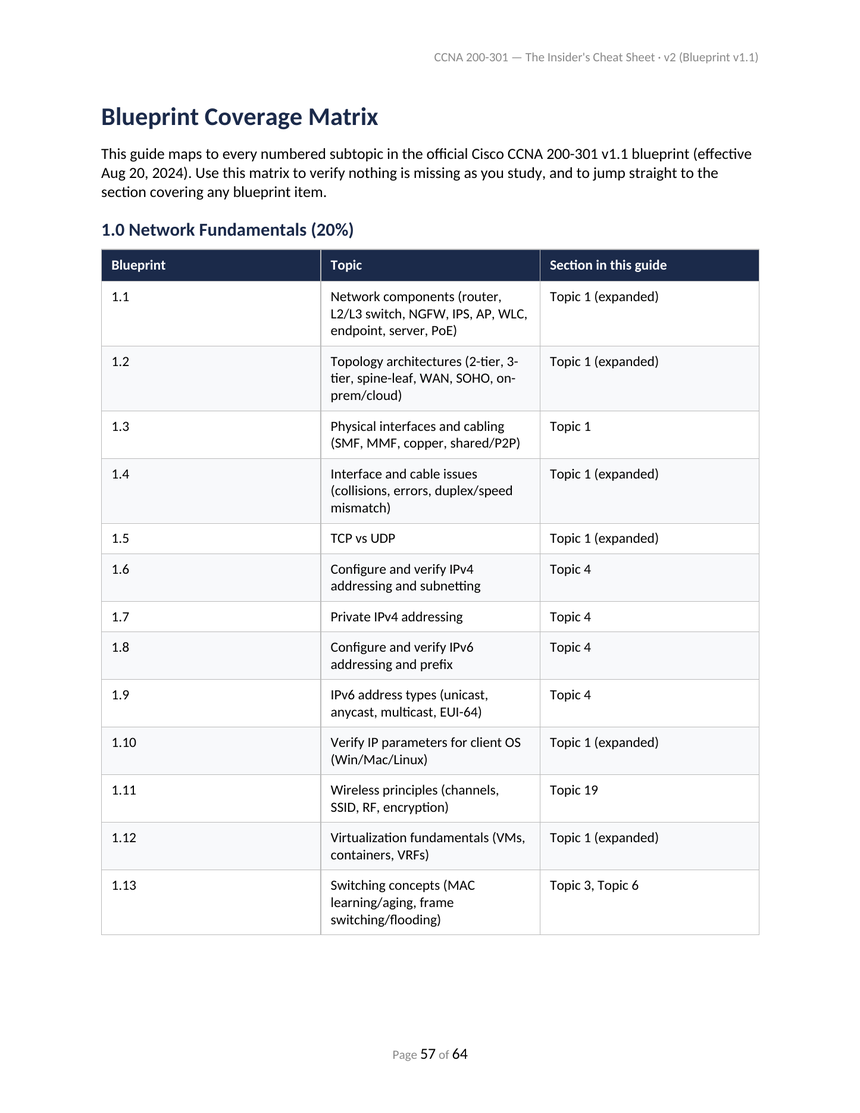
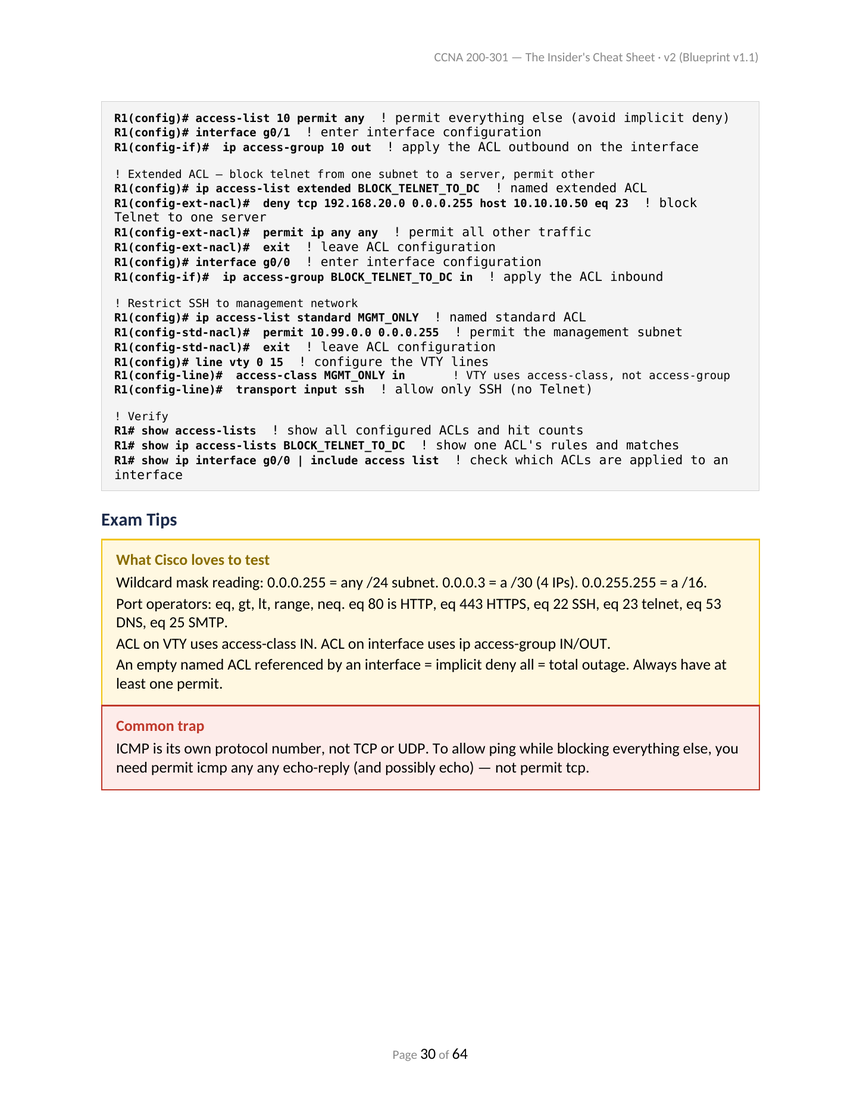
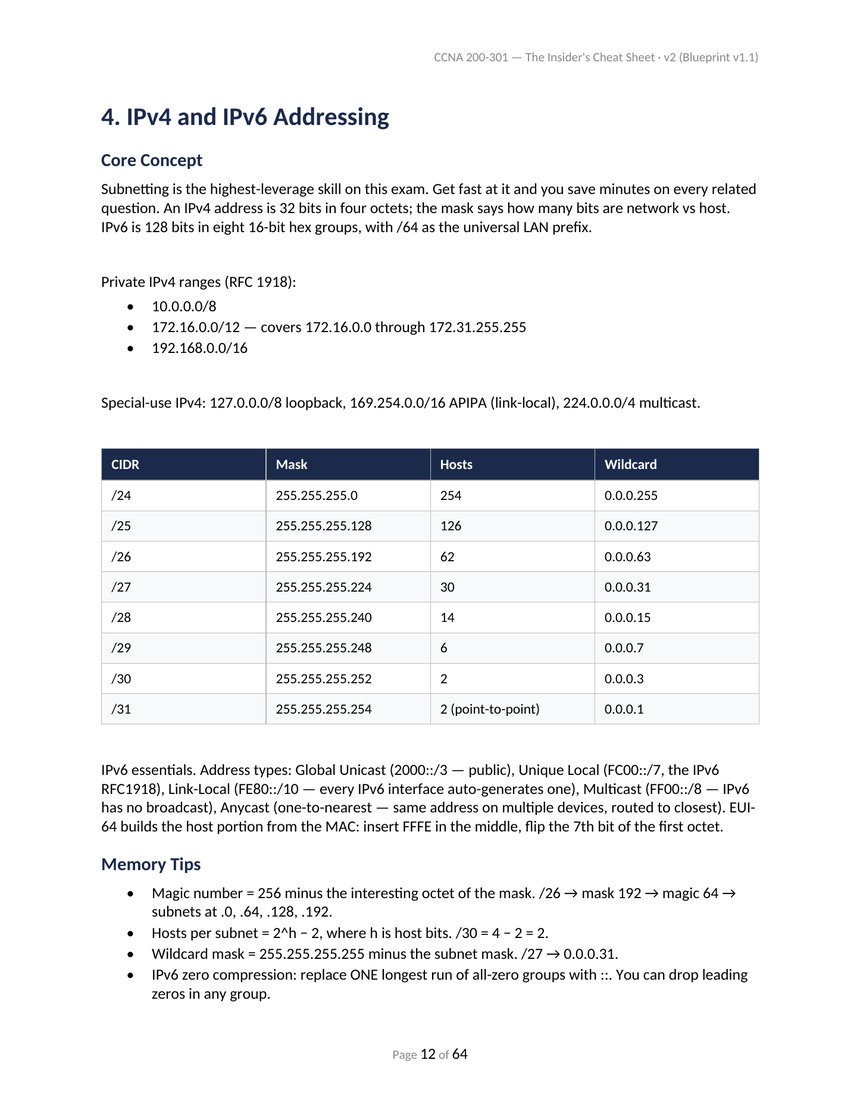
Most study guides ask you to trust a sales page. These are real pages from the manuals — the coverage matrix, the lab-tested CLI, the test-day tip boxes. Judge the density yourself.


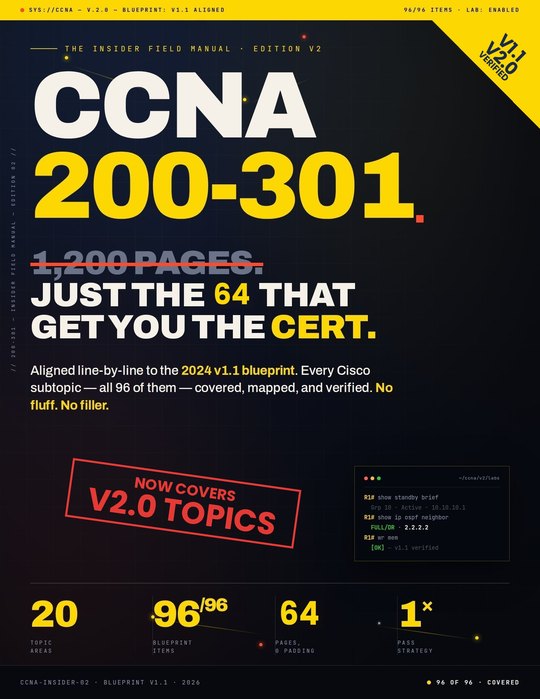
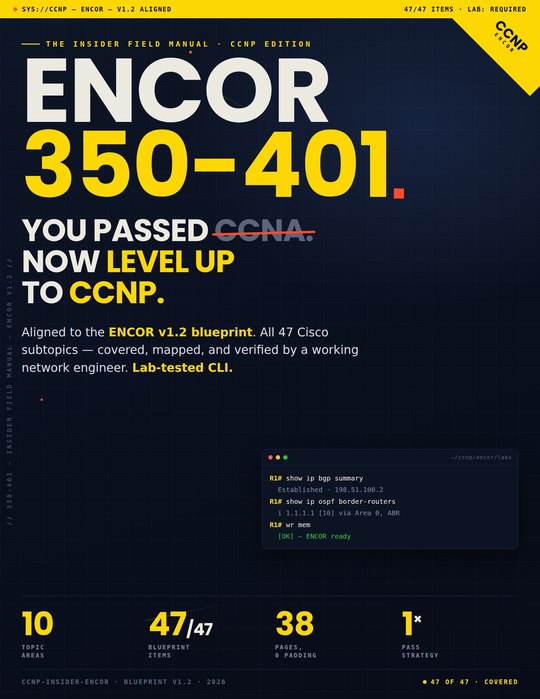
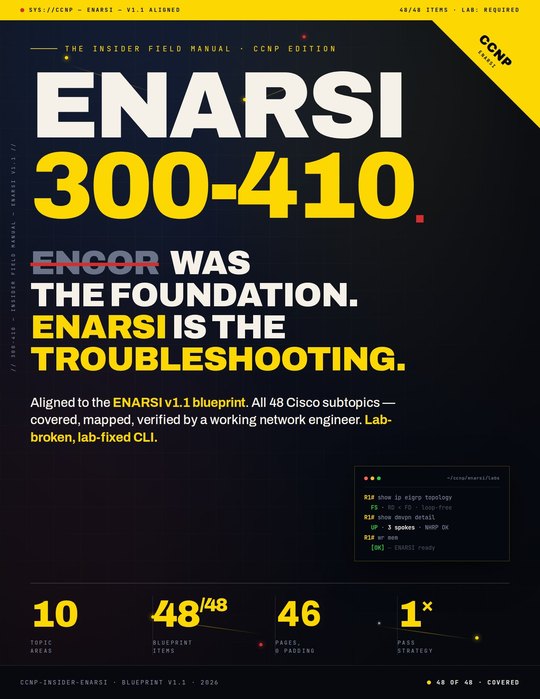
▲ Actual pages from the 64-page CCNA 200-301 manual. All three guides are built to the same standard.
Every concept in every guide solves a specific way the textbook approach has been costing you time, points, or confidence.
The CCNA v1.1 blueprint has 96 numbered subtopics, and Cisco can pull from any of them. Miss one, lose points you can't spare. Every Field Manual maps each subtopic to its section — across all three guides — so you spot-check what you're shaky on and move on. No more “did I miss something?” at 2am.
You've burned an hour on a tutorial whose config didn't work — wrong prompt, outdated syntax. Every command in every guide was typed into a real router by me. Not pseudo-code, not auto-docs — the exact CLI you'd run in a live network.
! EIGRP named mode — actually tested R1(config)# router eigrp CAMPUS R1(config-router)# address-family ipv4 unicast autonomous-system 100 R1# show ip eigrp topology FS · RD < FD · loop-free
You don't have time for theory — you need to know it, remember it, and recall it under pressure. Every topic follows the same rhythm: core concept in plain language, memory hooks that stick, real-world CLI you can lab tonight, and exam tips for what Cisco actually tests. The rhythm your brain will thank you for at hour 47.
A passing CCNA score is roughly 825/1000 (Cisco doesn't publish the exact line). Most who fail miss by under 50 points — almost always on predictable traps: wildcard vs subnet masks, OSPF stuck in ExStart, an EIGRP K-value mismatch. Every topic ends with a red callout showing exactly where those points walk off. So they don't.
Most CCNAs go for the CCNP ENCOR next — and CCNP Enterprise takes two exams, not one: the ENCOR core plus a concentration like ENARSI. The bundle is the whole path, at 20% off.
Read a full topic free first — same density, same formatting as the rest of the guide. What you see in the sample is exactly what you get.
Read a free CCNA sample →A quick note from the author: I'm Don. I hold two CCIEs, I've sat these exams, and I've coached engineers through them. I built these manuals because I was tired of watching sharp people fail — not for lack of brains, but because the textbook buries the small slice that's actually tested. This is that slice, and nothing else.
Your first Cisco cert and the hardest one to start. Every domain mapped, every CLI tested, every exam trap flagged.
The CCNP core exam and the gateway to senior roles. SD-WAN, SD-Access, BGP, automation — at CCNP depth.
The concentration most candidates avoid. MPLS L3VPN, DMVPN, route reflectors — built for the harder path.
The Field Manuals are DRM-protected, watermarked PDFs. Your purchase unlocks the guide on one device, and printing is disabled — that's how I keep the material from being copied and passed around.
Studying across two machines? Add an additional-device license for $9.97 one-time and the same guide opens on a second device too.
Yes — every guide is aligned to the blueprint Cisco publishes for that exam. CCNA is on the v1.1 blueprint (all 96 subtopics); ENCOR (all 47) is on v1.2; ENARSI (all 48) is on v1.1. Each includes a coverage matrix mapping every subtopic to its section.
If I correct or improve a guide, existing customers of that edition get the update free. When Cisco releases a new exam version, that's a new, separate guide — a new purchase, not a free upgrade.
Most candidates start at CCNA, then take the two CCNP Enterprise exams — the ENCOR core and a concentration like ENARSI. The bundle covers all three guides and saves you $11.94 versus buying them one at a time.
Because I'd rather every engineer afford it before payday than price it like a $2,000 bootcamp. It's dense reference, priced to be a no-brainer — not because it's thin. Read the free sample and judge the density for yourself.
You get the guide instantly — your download is ready the moment checkout completes. Your DRM license follows shortly after by email: each copy is watermarked and keyed to you (that's what stops it being copied and resold), so the license is what activates your personal copy. You'll also receive a separate email that walks you through how to access and open your guide.
The guides open in the free Locklizard Safeguard Viewer. You install it once, activate your license, and from then on the guide opens with a double-click. Minimum versions:
Two things cause most of the "my license won't activate" emails I get. First: activate on the machine itself — not over VPN, RDP, Citrix, or a terminal-server session, which Locklizard blocks by design. Second: the Viewer needs outbound access on ports 80 and 443 to reach the licensing server, so a strict corporate firewall or endpoint agent can stall it. Activating from home usually clears both.
There is no Linux build of the installed Viewer. If a Linux box or a Chromebook is your only machine, email me before you buy and I'll tell you straight whether I can get you running.
Requirements checked against Locklizard's published downloads page and the current App Store / Google Play listings — August 2026.
Picture exam morning — no cramming, no second-guessing, because you've already seen exactly what's coming. Three guides, 148 pages, the entire CCNA → CCNP Enterprise roadmap.